

The Top 10 M. Night Shyamalan Films
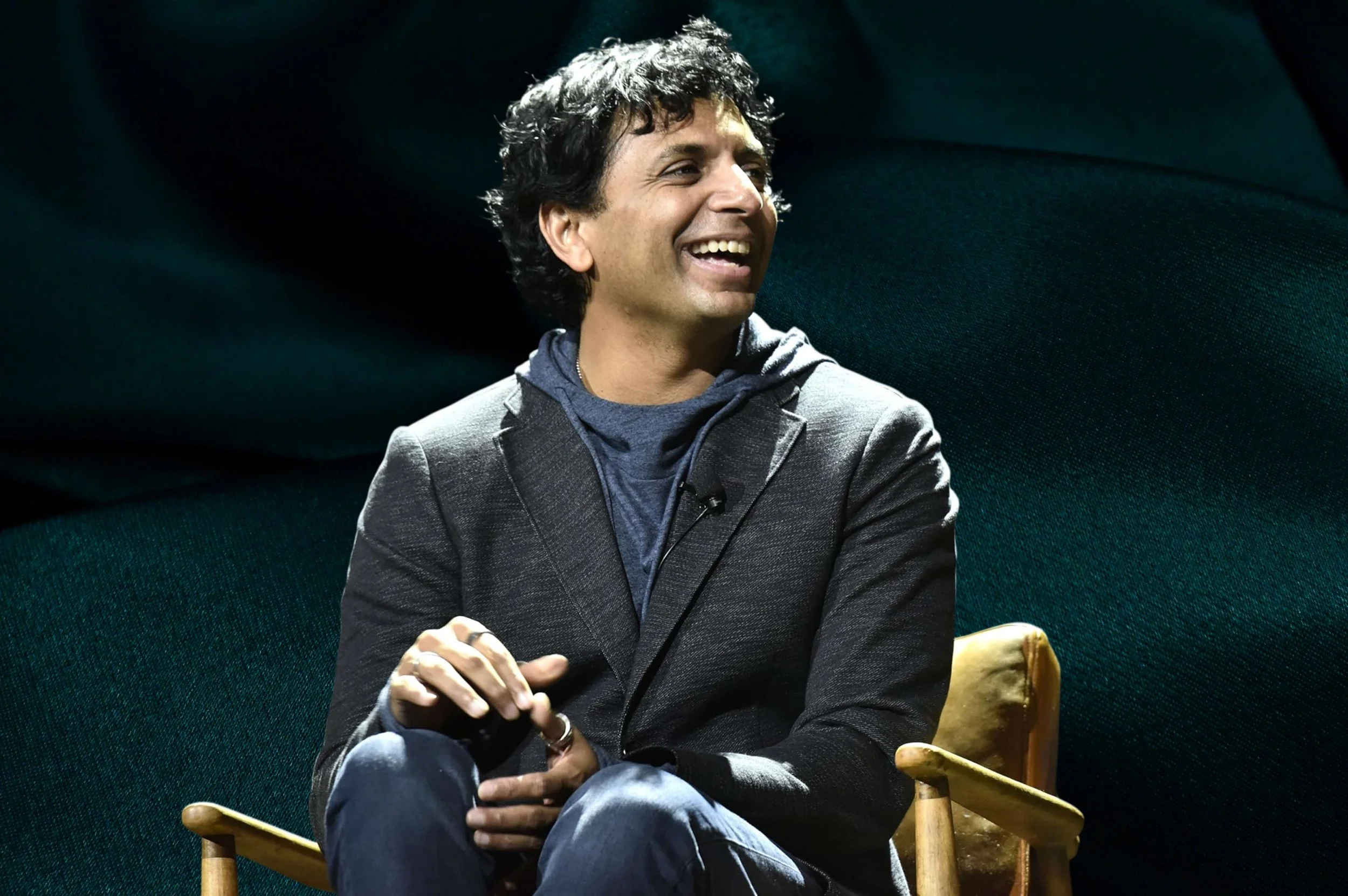
Eugene Gologursky
There is perhaps no writer or director in history with a more polarizing filmography than M. Night Shyamalan. Born in Mahé, India, Shyamalan’s parents immigrated to the United States when he was just six weeks old. At a young age, he gained a desire to be a filmmaker, and by the age of 17, he had made 45 home movies. Shyamalan’s first foray into feature filmmaking came when he made the semi-autobiographical drama Praying with Anger. The rest is history.
As mentioned earlier, Shyamalan is a polarizing filmmaker, one who thrives in low-budget and low-stakes thrillers and horror films. Perhaps that is why Shyamalan is such a draw for so many people; the man’s greatest consistency is that he is inconsistent. For every tightly written horror story with a mind-bending twist that leaves viewers shocked for years to come, there’s a failed blockbuster with overly expository dialogue, poor camerawork, and bad and choppy editing. The plot twist is what most stands out when it comes to Shyamalan. It has become his defining characteristic, but that’s not all he has going for him. He enjoys slow-burn pacing to build tension, unsettling atmospheres, and (mostly) grounded tone. His work behind the camera involves long takes, bold colors, static cameras, and exact blocking, all meant to achieve expressive realism and the aforementioned storytelling devices.
Shyamalan has succeeded as often as he has fallen short, but never has he lost his identity. When he succeeds, he does so in a way that no other director could. He has been nominated for a handful of accolades, specifically for Best Director and Best Screenplay at the Golden Globes, BAFTAs, and the Academy Awards. Shyamalan has also won a few Razzies. This list will be a showcase of his accomplishments rather than the blemishes. Shyamalan’s best work is both polarizing and fascinating, so let’s find out which of his many films is truly his finest work.
10. Praying with Anger
Year: 1992 | Genre: Drama
Premise: Written by Shyamalan, this film follows Indian American Dev Raman, played by Shyamalan, who returns to his native country to spend a year as part of a college exchange program. Over the course of the film, he examines his identity, exploring the clash of Western values and those of the Indian subcontinent.
Directing: Everyone has to start somewhere, and in the case of M. Night Shyamalan, it was with a shoestring budget, a small cast which included himself as the lead, and a simple story about a boy returning to his roots. Like some directorial debuts, there are certainly facets of Shyamalan’s future films that originate from here. Yet, this is not the film where all of his unique quirks as a filmmaker began, and his identity is still in the making.
As a result, Praying with Anger stands as a fascinating piece of film history as well as an incredibly unique film among Shyamalan’s filmography. It is his most experimental work and demonstrates the man’s skill at utilizing a limited cast and small budget. The fact that he manages to squeeze as much substance into such a small film is a testament to his skill as a writer. It is no wonder that Shyamalan thrives in lower-budget, character-focused stories since this was his first. It is a prototype of Shyamalan’s work, one that remains important in his career and is arguably his most personal work.
The film won the First Film Competition for Independent Filmmakers at the 1993 AFI Fest.
9. Glass
Year: 2019 | Genre: Horror/Action
Premise: Written by Shyamalan, this film is the third and final film of the Eastrail 177 or Unbreakable trilogy. It is the direct sequel to Split and follows David Dunn, played by Bruce Willis, as he tracks down Kevin Wendell Crumb, played by James McAvoy. The pair are taken to a psychiatric facility where Elijah Price, aka Mr. Glass, played by Samuel L. Jackson, is held, and he has plans for them both.
Directing: Despite being the final film of a trilogy with nearly 20 years of buildup and experience behind it, Glass has become widely regarded as the weakest of the trilogy, with some deeming it a disappointing conclusion. It certainly suffers the most when it comes to Shyamalan’s need to outdo his previous twists, leading to a film that doesn’t quite have the tight drama of its predecessors, but neither does it have the necessary stakes or scale worthy of a finale.
That being said, the directing on display is still good, with Shyamalan taking what worked from Split and elevating it. It was always going to be difficult to depict the battle between de-mystified superheroes, but Shyamalan does a good job of making the showdowns between Kevin and Dunn exhilarating. But perhaps his strongest work here is when the three main characters are together, utilizing vivid color and wide angles to wordlessly showcase the dichotomy between the three men. It is a flawed mess full of poor choices and sheer brilliance, much like Shyamalan’s entire career.
The film was nominated for Best Action or Adventure Film at the Saturn Awards.
8. Wide Awake
Year: 1998 | Genre: Family/Comedy
Premise: Penned by Shyamalan, the film follows a 10-year-old boy named Joshua Beal, played by Joseph Cross. Joshua must go on a personal journey following the death of his grandfather, reckoning with his grief and his faith as a Christian in order to find out the true meaning of life.
Directing: This is M. Night Shyamalan’s second film and introduces more of his signature storytelling features. Shyamalan deals a lot with spirituality, the supernatural, and purpose in his films, and this is arguably where some of it began. These themes can be found in his very best work, and this film certainly showcases that Shyamalan is capable of switching genres, for better or worse.
Wide Awake is a children’s film that deals with heavy subject matter. Shyamalan’s direction certainly works to immerse the audience in Joshua’s perspective, but it also showcases his odd quirks when it comes to presenting children in films. Many are intelligent beyond their age but often have to grow up quickly due to trauma. Shyamalan does good work to help Joseph Cross with his performance, but other child actors feel stilted and inconsistent. It’s yet another film where Shyamalan is still figuring out his style and thus is important in his career, but it’s all too easy to forget about Wide Awake, considering the film that followed it.
7. Trap
Year: 2024 | Genre: Crime
Premise: This film follows Cooper Abbott, played by Josh Hartnett, taking his teenage daughter Riley, played by Ariel Donoghue, to a concert. The concert, however, has a large police presence, and it’s discovered that they are on the hunt for a serial killer named “the Butcher,” who, unknown to the police, is actually Cooper himself.
Directing: Trap is a fascinating film and one of the best representations of the many reasons M. Night Shyamalan is so beloved. Depending on the viewer, this film could be a truly tense thriller with an inventive premise, an eerie lead performance, and thematically strong with ideas of parenthood and trauma. However, it could also be seen as a hilariously nonsensical story following an inept serial killer surrounded by even more inept police with a strong case of nepotism. Either way, someone is having fun watching this film.
Shyamalan’s heavy use of close-ups here leads to a general sense of unease, especially when it’s placed in front of Josh Hartnett. When the film is in the concert hall, there is a good amount of tension following Cooper throughout. Shyamalan does well to immerse the audience in Cooper’s perspective, offhandedly showing the means of escape that might not be obvious at first glance. It may run a bit long and be unable to maintain the momentum once Cooper leaves the concert, but Trap still remains a fun ride throughout. It all depends on which aspects of Shyamalan one likes most.
6. The Visit
Year: 2015 | Genre: Horror
Premise: Written by Shyamalan as well, the film centers around two siblings, Becca, played by Olivia DeJonge, and her younger brother Tyler, played by Ed Oxenbould. They go to stay with their estranged grandparents, but during their stay, the pair find that their grandparents start to act bizarrely. The siblings must work to find the truth behind the strange circumstances at the farmstead.
Directing: Following up on the disasters of The Last Airbender and After Earth would be tough for any filmmaker. These two films are often considered some of the worst of all time, and bouncing back from them seems like an impossible task. Thankfully, Shyamalan returns to his roots with The Visit, delivering a unique, tense, low-budget horror film that arguably reignited his career.
Shyamalan’s style lends itself very well to found footage films. His excellence with a static camera and close-ups results in incredibly eerie scenes where little seems to happen. The background and environment are utilized excellently to make the audience become scared of even the smallest movements. The horror could be anywhere in the house, and the grandparents are a constant threat.
5. Split
Year: 2016 | Genre: Horror
Premise: Casey Cooke, played by Anya Taylor-Joy, and two other teenage girls are kidnapped and held in an isolated underground facility. Their kidnapper is Kevin Wendell Crumb, played by James McAvoy, who has dissociative identity disorder, which results in him having 23 distinct personalities. Casey must escape and learn the truth about Kevin before the 24th and most dangerous personality emerges.
Directing: At a time when Shyamalan’s career was seemingly tarnished by a few failed blockbusters, The Visit gave him his confidence back. As a result, Split came along to remind everyone that he could still deliver a tense, low-budget horror film with fantastic performances and mind-blowing twists that still elicit chills whenever it is rewatched.
The main praise for this film is often directed at the absolutely powerhouse performance by James McAvoy, but there is no doubt that Shyamalan’s direction massively elevates it. Static camera and close-ups allow the subtleties of personality change to come across clearly and eerily. Perhaps the biggest testament to the direction here is when the final personality comes through. In a lesser filmmaker’s hand, this could look ridiculous, but Shyamalan makes The Beast as terrifying as it was built up. The ending of this film is iconic and a stroke of genius by Shyamalan, regardless of the quality of Glass.
4. The Village
Year: 2004 | Genre: Horror/Mystery
Premise: The film takes place in 19th-century Pennsylvania, in a small, remote village where the people live in fear of nameless humanoid creatures dubbed “Those We Do Not Speak Of,” that inhabit the surrounding woods. When a willful young man ventures in, it is up to a blind young woman to save him, which leads to the revelation about the “creatures.”
Directing: Shyamalan is often considered as the director who always has a twist up his sleeve. Whenever an M. Night Shyamalan film comes out, the first question on everyone’s mind is about the twist. The Village is arguably the film that really emphasizes this idea about Shyamalan, since it is full of twists and turns that work surprisingly well. At the time of its release, the film was not well-received, but it has since been reevaluated as one of Shyamalan’s strongest films.
The Village is dripping in atmosphere. The village itself feels like a character in and of itself. Everything that is unique about Shyamalan’s filmmaking gives the village a feeling of unease. His odd dialogue and static camera give a sense that something is wrong. Shyamalan uses color as an essential aspect of the story, playing a major part in the twists. As the secrets are unravelled, the film is constantly recontextualized, and the audience is forced to reevaluate it. The Village is one of Shyamalan’s best and becomes more and more beloved as time goes on.
For his work, Shyamalan was nominated for Best Director at the 10th Empire Awards.
3. Signs
Year: 2002 | Genre: Sci-fi/Horror
Premise: Set primarily on a farm, the film follows a former priest who discovers mysterious crop circles on the land. His home later comes under siege by aliens, and he and his family must do what they can to survive whilst he grapples with the loss of faith due to the death of his wife.
Directing: Another iconic film in Shyamalan’s filmography, Signs takes the huge stakes scenario of an alien invasion and grounds it with the perspective of a well-developed set of characters. Each family member feels unique, and Shyamalan’s discussion of faith is so unique and one-of-a-kind. The tension is once again well-built, the family dynamics excellently defined, and the cinematography immerses the viewer.
This film has many background elements that serve as setup, mainly the baseball bat and the water. Shyamalan once again uses the background to tell the story rather than showing it directly to the audience. He emulates Spielberg in a way that feels both distinctly Shyamalan yet retains the fear and wonder of Spielberg’s alien films. Signs is yet another film that time has been kind to, and it stands as one of the most unique takes on an alien invasion.
2. Unbreakable
Year: 2000 | Genre: Thriller
Premise: David Dunn, played by Bruce Willis, is a security guard and the sole survivor of a catastrophic train crash. More miraculously, he survived without sustaining any serious injuries. His superhuman abilities draw the attention of Elijah Price, played by Samuel L. Jackson, who believes the answer to David’s problem lies inside the pages of comic books. Learning more about his abilities leads David down a path of vigilantism and subsequent heroism as he becomes The Overseer.
Directing: In the current world dominated by superhero blockbusters and incredible comic book adaptations, Unbreakable feels all the more unique. It was unique at the time it came out by taking a one-of-a-kind look into the medium of comic books and demystifying the idea of superheroes, placing them in a realistic setting. Through this device, Shyamalan explores existentialism, survivor’s guilt, the pros and cons of purpose, and the nature of good and evil.
The direction and color make Unbreakable feel like a comic book. Every main character seems to have a signature color, with David Dunn and Elijah Price being defined by a green and purple that is now iconic. Every shot is composed to look like a comic book panel, highlighting the medium’s importance and ability to deliver emotional stories. The long takes are excellently composed to truly immerse the audience in this world. Shyamalan’s direction perfectly portrays the headspace of David Dunn, as he now sees the world in a different light in the wake of his survival and the discovery of his abilities. As the years go on, this film becomes more and more iconic and timeless and is such a unique take on superheroes. It is a film that only M. Night Shyamalan could have made.
1. The Sixth Sense
Year: 1999 | Genre: Horror/Mystery
Premise: Child psychologist Malcolm Crowe, played by Bruce Willis, must help a troubled child named Cole Sear, played by Haley Joel Osment. Cole claims he can see and communicate with the dead, who haunt him repeatedly. Crowe’s own trauma becomes intertwined with this case, all leading to an earth-shattering revelation about who he truly is.
Directing: Was there really any doubt as to what would be number one? The Sixth Sense is permanently engraved into modern pop culture and into cinematic history. It has by far one of the most shocking plot twists to ever grace film, to the point it might not even be considered a twist anymore. It embodies the best of Shyamalan’s traits, and it is only his third film. This firmly established Shyamalan’s identity for better and worse.
This film is also one of Shyamalan’s scariest; the visions that Cole sees are horrifying, unique, and impeccably directed and acted. It is truly terrifying seeing all this from the perspective of a child, and Shyamalan does not hold back with the horror. Yet, there is a fundamental warmth at the heart of the story with the relationship between Cole and Malcolm as the two work to get to the bottom of Cole’s condition. It results in a film that goes from terrifying to heartwarming masterfully. Shyamalan has yet to reach the heights of this film, and he may never will, but he has solidified his place in cinema history with this film.
This film was nominated for six Academy Awards, including Shyamalan’s first nominations for Best Director and Best Original Screenplay.