

Debut: ‘Sideral’ Is Out Of This World–Literally
Carlos Segundo’s Sideral presents a facade of mundanity that conceals the short’s true nature: an unflinching, slice-of-life examination of the silent struggles of motherhood. The short sneaks up on you with a deliberate, slower pace, but within the narrative lies a depth that interweaves brilliant visuals with the subdued strength and sorrow of a mother.
Set in the northern Brazilian city of Natal, Sideral follows a family of four led by an unnamed matriarch, known only as Mère (Priscilla Vilela). Brazil is preparing for its first-ever crewed rocket launch, an exciting time for all, especially for Mère’s son Felipe (Matheus Brito), whose first introduction highlights this. He stares off in a daze at a rocket-shaped lava lamp that sits next to his bed, his imagination visibly reaching far beyond our planet.
Mère’s introduction is understated; she washes dishes, frustratedly, at that, suddenly stopping to throw one without a word before lighting a cigarette. Her distress is clear, but her pain within it is subtle. She is depicted as the children’s primary caretaker, tucking them in, doing housework, and navigating affliction—forced to carry these burdens alone. A radio, discussing the following day’s rocket launch, plays in the background, inviting audiences to form a connection between this paramount event and Mère’s fragile state of mind.
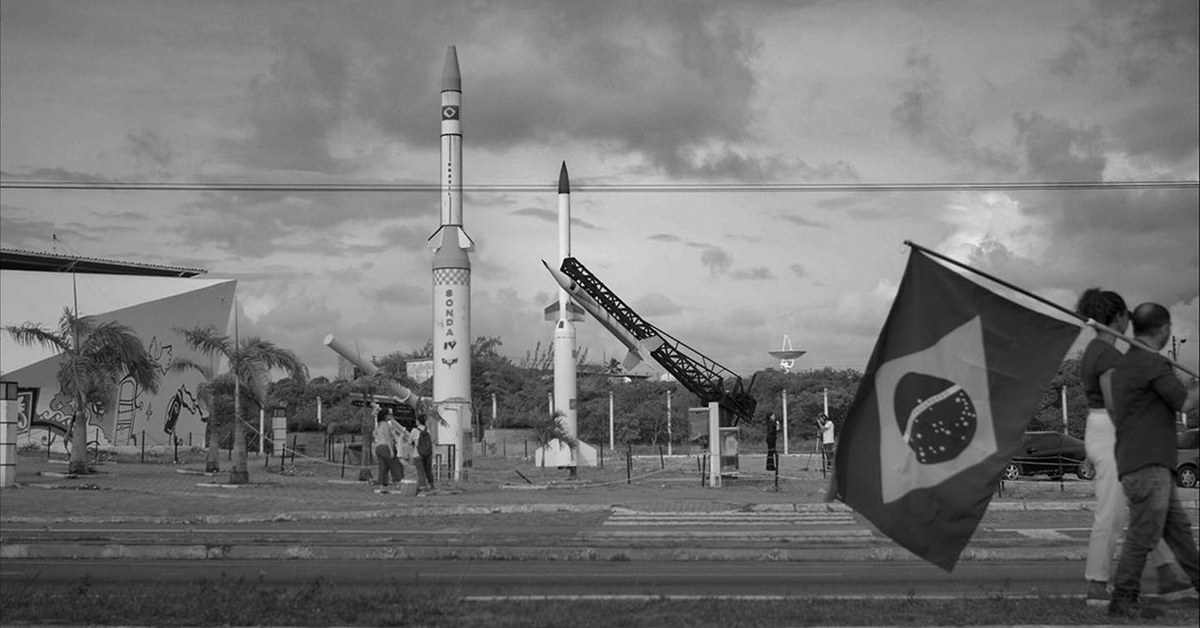
Photo Credit: Tropical Alien
The film’s breathtaking black-and-white cinematography allows every scene to breathe. Rather than a constant stream of dialogue, moments in Sideral never hesitate to linger, often for longer than they need to, but it works. The camera’s position remains primarily fixed, and a scene detailing the scenery outside of the rocket launch employs the technique effectively. A couple walks by holding a Brazilian flag; cars zoom past; nature buzzes. The simplistic mise-en-scène creates a fly-on-the-wall perspective, where the camera’s stillness contrasts with the setting’s vibrancy. This aids in conveying the national excitement and importance of the launch, creating a world where it permeates the air.
On the day of the launch, Père (Enio Cavalcante), Mère’s husband, makes his first appearance, driving her on a motorbike to her job as a cleaner. She remains subdued throughout what proves to be her final conversation in the short. “I’m tired,” Mère says. Père responds dismissively, “You only just got here.” Silence ensures. She stares off into nothingness, reaching an invisible breaking point. Eventually, Père is the one to break the silence, disregarding her subtle cry for help, and instead moves on to a different topic. This interaction is likely the straw that breaks the camel’s back for Mère.
In an unexpected turn of events, military personnel arrive at the family home, revealing that Mère has secretly concealed herself inside the rocket ship. She has taken off with the crew, now stuck in space for the duration of the mission; two whole years. Her husband’s response contains a noticeable lack of concern for her well-being: “What am I going to do with the kids?” Up to this point, Père has mostly been shown at work, never at home with his wife and kids. The disparity in their parental roles suggests Mère’s drastic decision to flee the planet stems, at least partially, from the inequalities of their marriage.
The only time Mère’s frustration becomes outwardly visible is when she washes dishes–a traditionally domestic task thrust upon women and mothers. While these antiquated ideologies are contemptible, the two’s marriage seems to be rooted in them. Père is unfeeling and distant, visibly prioritizing his job and social life over his wife and children. Mère detests this, as seen in her outburst, albeit silent, but with her children to worry about, it proves difficult for her to take action.
Mère’s job as a cleaner, a traditionally feminine role, further emphasizes her confinement within gender roles. She remains nameless throughout the narrative, while her husband is given a name– “Mister Marcos,” the military personnel call him–exemplifying yet another imbalance in their marriage. Mère remaining nameless allows for accessibility to her character; she could be any mother or wife, stuck within the shackles of toxic masculinity and outdated tradition.
These tensions are subtle, so much so that a rewatch is likely necessary to fully unpack the short’s nuances. One of the military officials states, “[Mère] hasn’t undergone training, we think that up there, she’ll have to keep working, as a cleaner.” Even up in space, miles and miles above Earth, she is unable to escape the confines of these roles imposed on her. The system’s grip remains so iron-clad that Mère is merely reduced to her labor once again, even in this new, uncharted space.
A notable shot features Felipe lying on his back, staring up at the sky. One of the military officer’s hats rests beside his legs; his rocket ship lava lamp is close by, pointing upward toward his mother. Many of the short’s most expressive moments contain only sounds of nature. There is no need for discussion when every frame tells a story. Even with a compact runtime, Sideral rushes nothing, allowing time to pass authentically. The nuances beneath what initially may be perceived as mundane prove to be out-of-this-world, literally.
The film’s conclusion introduces its only color: a galaxy. Is this a representation of Mère’s freedom from the monotony of her life, restoring the color she may have lost over the years? Or does it symbolize the uninhibited nature of the unknown, contrasting with the limitations women face in the confines of Earth? The short offers no definitive answers, inviting the viewer to walk away with more questions than they began with. A multitude of potential interpretations mark the short’s success, opening a new universe within the viewer’s mind, and pushing the boundaries of what film can achieve.