

Rethinking Daytime Part 1: Premise and Setting — The Power of Staying Put

While there are several similarities on the surface between American daytime dramas and British nighttime soap operas, they are very different in practice. All these serials air daily or multiple times a week and follow multiple concurrent storylines. However, British soaps like Coronation Street, EastEnders, Emmerdale, and Hollyoaks have remained culturally relevant while, over the years, General Hospital, Days of Our Lives, The Young and the Restless, The Bold and the Beautiful, and Beyond the Gates have struggled to remain popular with American audiences.
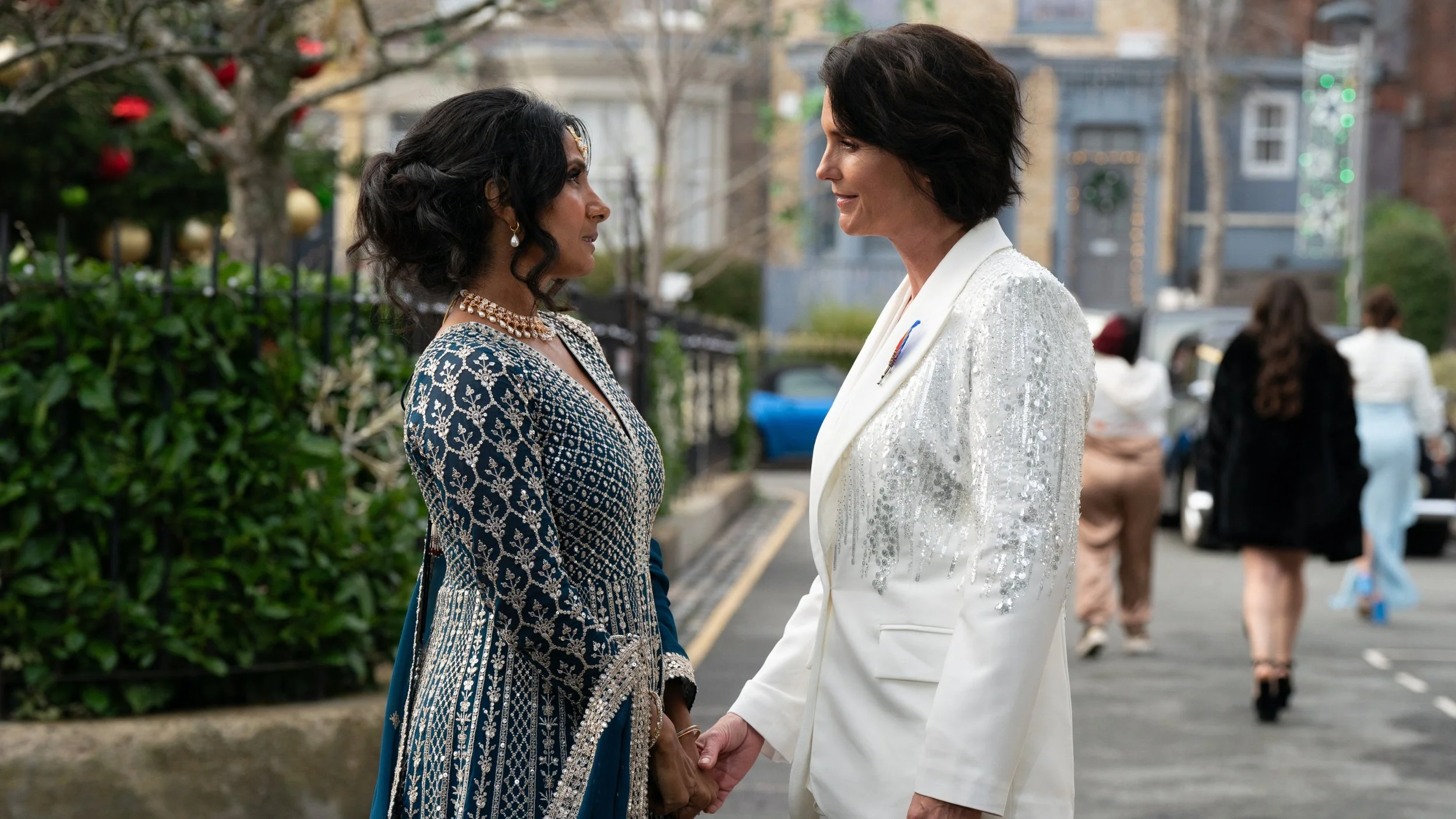
Balvinder Sopal and Heather Peace - eastenders/bbc
United Kingdom: It shouldn’t come as a surprise that British soaps have remained relevant with their audiences. In many ways, British nighttime soap operas reflect the everyday lives of their viewers. This keeps audiences coming back because they see themselves represented on television. British contemporary soaps do this by rooting their narratives in modern social issues. For example, the most popular soap operas in the United Kingdom have addressed hot-topic issues that weren’t discussed on television 30 or 40 years ago, such as sexual and gender identity, incel behavior, and timeless issues like domestic violence.
The BBC primetime soap opera EastEnders depicted a main character’s struggle with her sexuality throughout the early 2020’s. In the narrative, Suki Panesar-Unwin (Balvinder Sopal) began developing feelings for Eve Unwin (Heather Peace). Panesar-Unwin struggled to come to terms with her romantic feelings for women, while Unwin is an out-and-proud lesbian. At the same time, Panesar’s abusive ex-husband, Nish Panesar (Navin Chowdhry), is about to be released from prison. The storyline was significant for its juxtaposition of sexual identity struggles with domestic violence, and the difficulties of a closeted bisexual woman being involved with a woman who is openly gay.
On the E4 primetime soap opera Hollyoaks, the character of Mason Chen-Williams (Frank Kauer) was groomed into becoming an incel by school janitor Eric Foster (Angus Castle-Doughty), after being taunted by his classmates and unable to make friends. During this time, he develops harmful beliefs about women and commits several questionable actions. His behavior develops into misogyny when he releases inappropriate photos of a classmate online, as revenge for her not returning his feelings. This narrative depicted how, under certain circumstances, young people can be manipulated into developing unhealthy beliefs and displaying dangerous behaviors that harm others and change the trajectory of their lives forever. The story ended with Chen-Williams owning his behavior and facing the consequences, realizing the impact his actions had on the people he hurt.
Another element that keeps British primetime soaps relevant is their ability to stay true to their original premises. Shows like Coronation Street, EastEnders, Emmerdale, and Hollyoaks, despite being on the air for years and juggling multiple cast changes, have never lost touch with their identities. For example, ITV’s Coronation Street has followed the residents of Weatherfield since its inception, giving viewers a stable and familiar setting to follow for half an hour every night. There is a sense of safety for viewers in that they’re returning to a world they’re comfortable with and have followed for several years. At the same time, the town of Weatherfield depicts a largely middle-class community that reflects the lives of several viewers, rather than the glitz and glamour shown on several American daytime dramas.
Similarly, ITV’s Emmerdale has been set in the same fictional village and followed the Sugden family since its debut. Aside from the fictional city, the local public house, The Woolpack, is "the heart of the community" in Emmerdale. Although several characters have come and gone, viewers know when they tune in every day what to expect: meaningful stories following compelling and three-dimensional characters in a familiar setting.

Melissa Ordway and Bryton James - the young and the restless/cbs
United States: On the contrary, American daytime dramas, over the years, have drifted far from their original premises and frequently feature outlandish storylines that would never happen in real life. Some of these storylines have even featured supernatural or science fiction elements. For example, ABC’s General Hospital, the longest-running American daytime-drama on the air, originally followed the day-to-day happenings of a fictional hospital of the same name, but now features very few hospital-based storylines.
It didn’t take very long for General Hospital to stray from its original premise. By the 1980s, only about 20 years after its debut, the Cassadines were inventing weather machines to freeze the world. In the 90s, the character of Robin Scorpio-Drake (Kimberly McCullough) made friends with an alien named Casey Rogers (Bradley Lockerman) from the star Lumina.
Still, General Hospital was keeping viewers engaged through impactful storylines depicting social issues. In the 90s, Scorpio-Drake was diagnosed with HIV, which she lives with to this day. However, her boyfriend, Stone Cates (Michael Sutton), developed AIDS, which led to his death. That same decade, Port Charles newcomer Elizabeth Webber (Rebecca Herbst) was raped in the snow and left by her attacker. These storylines reflected everyday struggles that audiences face, rather than the sensationalized mob and superspy stories depicted today.
Meanwhile, Peacock’s Days of Our Lives has frequently featured supernatural and out-of-this-world storylines. Originally focusing on the Suburban Horton family in the fictional town of Salem, Illinois, by the 1990s, Days of Our Lives veered into supernatural territory. Between 1994 and 1995, Stefano DiMera (Joseph Mascolo) triggered a demon that possessed Marlena Evans (Deidre Hall), causing her to levitate and speak in tongues. The story culminated in an exorcism performed by John Black (Drake Hogestyn). Similarly, a storyline in 2020 involved Dr. William Rolf (William Utay) implanting a microchip containing Stefano DiMera's consciousness into Steve "Patch" Johnson (Stephen Nichols).
Lastly, what American soap operas have in common is their lack of representation for people of color. While daytime dramas like General Hospital have depicted numerous storylines centered on social issues, most of them revolved around white characters. As of 2026, American daytime dramas still fall far behind in representation for people of color compared to their British counterparts.
Conclusion: British soaps have maintained their original, enduring premise by focusing on kitchen-sink realism, portraying the everyday lives of working-class communities, and nurturing homegrown talent. By grounding high-stakes drama in relatable, community-focused storylines, soaps like Coronation Street and EastEnders continue to act as cultural pillars. Contrastingly, American soap operas have shifted from slow-paced, realistic, domestic dramas targeting housewives to fast-paced, sensationalist storylines, heavily featuring supercouples, action, and fantasy. Driven by 1980s competition, they moved away from social issues toward escapism. Declining viewership and budgets have forced a reliance on formulaic plots and forced modernization, causing many to fade.
