

Rethinking Daytime Part Five: Social Relevancy — Writing the Present Tense
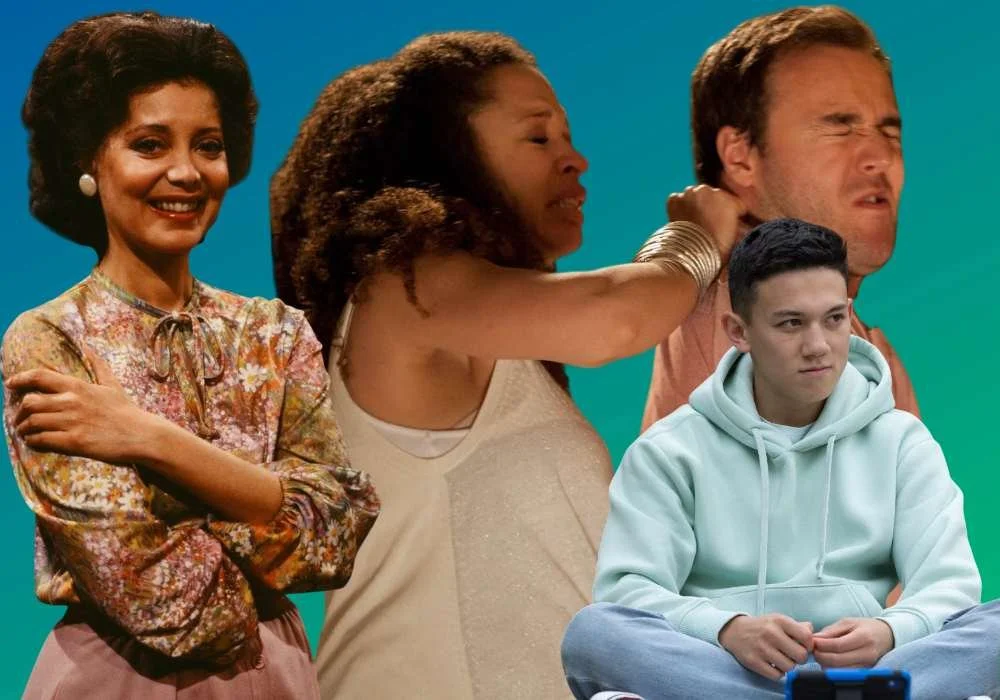
From left to right: Ellen Holly, Natalie Gumede, Alan Halsall, Frank Kauer
American Soap Operas and their British counterparts differ in their approaches to storytelling. Primetime soap operas in the United Kingdom frequently feature storylines that are relevant to the current social, political, or economic climate of the time. By contrast, daytime dramas in the United States often depict an idealistic world devoid of such topics. In doing so, American soaps are doing a disservice to their audience by presenting a world in which they aren’t seen. Through the incorporation of relevant social issues facing people of color in the United States, such as police violence and racism, American daytime dramas can tell stories that resonate with their audiences.
United States: Several American soap operas have become well-known for depicting relevant social issues of the time. For example, ABC’s One Life to Live featured a Black character, Carla Gray (Ellen Holly), passing as white for several months from 1968 to 1969, soon after the soap’s debut. Similarly, Beyond the Gates has depicted storylines addressing timeless issues like racism and classism, as well as contemporary struggles such as social media stalking, since its February 2025 debut. In the United States, issues like racism and police violence have become so prevalent over the last few years that most daytime dramas are likely too afraid to touch them. However, the relevance of these issues, in addition to homophobia, gender equality, and women’s rights are precisely why the four remaining legacy soaps in the United States should be featuring these topics.
General Hospital: The longest-running American soap opera currently in production, General Hospital could do well by depicting modern social issues with a focus on people of color. For instance, the issue of women's bodily autonomy, particularly their rights during pregnancy, is currently a contentious issue. The character of Portia Robinson (Brook Kerr) is currently pregnant and at least 40 years old, making it a high-risk pregnancy. Discussion of terminating the pregnancy has been minimal. Given the current climate regarding women’s bodily autonomy and their right to choose, it’s irresponsible for the writers of General Hospital to not thoroughly acknowledge all of Robinson’s rights, especially considering the soap is set in New York, where abortion is still legal.
Days of Our Lives: The character of Sophia Choi (Rachel Boyd) was recently involved in a teenage pregnancy storyline on Days of Our Lives. Choi, at the time of her pregnancy, was becoming unstable and had a breakdown after birthing her son with Aaron Greene (Louis Tomeo), resulting in her being placed in Bayview Sanitarium for several months. Their son, Trey DiMera, is now living with his adoptive parents, Chanel (Raven Bowens) and Johnny DiMera (Carson Boatman). Now that Choi is back on the canvas, the soap’s best route to take would be for Choi to work on her mental health problems and face her post-partum depression head-on. On American soap operas, mental health issues are too often used as plot devices to explain a character’s questionable actions, and Days of Our Lives can use Choi’s character to change this narrative.
The Young and the Restless: One issue relevant to the history of The Young and the Restless is hearing loss/deafness. Within the soap’s narrative, Devon Winters (Bryton James) became deaf as a teenager in the 2000s after contracting meningitis while he was homeless. His hearing was miraculously restored in the early 2010s, and Winters has since had a son of his own, Dominic Phillip Newman-Abbott-Winters-Chancellor (Ethan Ray Clark), with his wife, Abby Newman (Melissa Ordway). The writers of America’s highest-rated soap could revisit this social issue by crafting a story in which Winters’s son becomes deaf, forcing Winters to revisit his painful past. This story would focus on Winters and Newman learning to raise a child with a disability, and Winters can help his son cope with his hearing loss through his lived experience.
The Bold and the Beautiful: This soap opera has the fewest actors of color in its cast and could benefit from exploring social issues affecting people of color. One social issue The Bold and the Beautiful could depict is police brutality. Legacy character Bradley Baker (Dan Martin) serves as the deputy chief of the Los Angeles Police Department (LAPD), putting him in a unique position regarding police violence. As a Black man, he understands the rocky relationship that people of color have with law enforcement, but working in the field shows him the good that the police can do for the community. By making Baker the center of this storyline, The Bold and the Beautiful can increase the presence of characters of color on the canvas and depict a compelling, multi-layered storyline that resonates with its audience.
United Kingdom: Soap operas in the United Kingdom, on the other hand, depict social issues more frequently and responsibly. On ITV’s Coronation Street, Kirsty Soames (Natalie Gumede) and Tyrone Dobbs (Alan Halsall) were involved in a compelling domestic abuse storyline. The long-running soap opera essentially “flipped the script” on domestic violence, portraying Soames as the abuser and Dobbs as the victim. The writers of Coronation Street effectively portrayed the cycle of violence with the backstory of Soames being abused by her father. Most importantly, the story ends with a positive message: Tyrone and Soames break the cycle of violence when Tyrone leaves her for good, and Soames turns herself in to protect Tyrone and their daughter.
The ITV soap opera Hollyoaks showed its ability to remain relevant with a storyline depicting Mason Chen-Williams (Frank Kauer) as an incel. Eric Foster (Angus Castle-Doughty), his school janitor, groomed Chen-Williams into developing harmful beliefs about women, leading him to make several questionable choices. During this time, he published a compromising photo of Leah Barnes (Ela-May Demircan), which he took while she was passed out drunk at a party. In the end, Chen-Williams makes amends with those he wronged before leaving England. The incel storyline on Hollyoaks was groundbreaking for its layered depiction of an ongoing issue that many people still don’t understand, and showed that, even though his actions can never be forgotten, Chen-Williams can change and find redemption by facing the consequences of his actions.
Conclusion: American daytime dramas and British primetime soap operas have significant differences in their approaches to storytelling. Primetime soap operas in the United Kingdom frequently present social issues in a responsible, sensitive manner. In doing so, these soaps remain relevant to their audiences by portraying struggles that viewers face in their own lives. Conversely, soap operas in the United States depict idealistic realities and don’t acknowledge real-world issues such as police brutality and teenage pregnancy. These soaps fail to keep up with the times and, in turn, lose relevance and alienate their audiences.
